October 1, 2011

Mitsubishi tickles the Triton

Heck, it seems like 4wdNewz is becoming a ute site (pickup, for North American visitors). Toyota has done Hilux, Ford has introduced Ranger and now Mitsubishi has announced a bunch of, albeit small, changes to the 4WD Triton, namely:
GL Single Cab
• Wider steel wheels and 245/70R16 tyres
• Grey painted wide flares
• New 2 DIN audio unit with Bluetooth and USB port (also on the GL Double Cab)
• Three-spoke urethane steering wheel with cruise control
GL Club Cab
• Braked towing up from 2700kg to 3000kg
• Wider steel wheels and 245/70R16 tyres
• Wide colour-keyed front flares and similar rear flares on the wellside
• 2 DIN audio with Bluetooth and USB port
• Three-spoke urethane steering wheel with cruise control
• Two additional tray hooks for a total of six 
GL Double Cab
• Wider steel wheels and 245/70R16 tyres
• 2 DIN audio with Bluetooth and USB port
• Wider colour keyed front and rear flares
• Three spoke urethane steering wheel with cruise control
• Two additional inner tray hooks 
GLX Double Cab
• Chrome grille
• 2 DIN audio with Bluetooth and USB
• Two additional tray hooks
GLS Double Cab
• Factory Bluetooth with controls on steering wheel
• USB port in glove box
• Chrome step bumper
• Two additional tray hooks

September 29, 2011

Ten things to like about the new Ford Ranger

4wdNewz has been to Oz for the New Zealand launch of Ford’s Ranger. These days it’s cheaper for a company to tag onto the end of an Aussie launch than stage one on our soil. Ford has done a fabulous job (see item 10) and I like the new truck for all sorts of reasons. Ten of these are listed below. You might have to click on 'older posts' to get to the end of the list.


There's a (shorter) list of things that aren't so great here.

It’s not a sports car, but …

Dumping the torsion bar for coils up front, throwing out the recirculating ball steering for rack and pinion, redesigning the rear leaf springs, and putting in the best electronics on a ute mean that the Ranger handles more like a sporting car than a truck. The rack and pinion steering is a revelation, yet doesn’t come back and bite on rough tracks. Many manufacturers already know this; rack and pinion pretty much rules in the 4WD world these days. The manual six-speed, once the driver is used to it, is heaps of fun. Close your eyes (no, don’t; you’re driving) and it might be a sporty car’s. Actually, it is; you’ll find it in the Mustang. Electronics tame the light rear end. It’s like a vehicle with a split personality – an on-road tourer, an off-road weapon.

Front towhook rated to 6000kg

Okay, it’s not snatch-recovery Nirvana, but full marks for effort. Too bad they didn’t do the same at the back.

A mechanical rear diff lock for all models

The locker is electrically engaged via a dashboard switch, like the Mitsubishi Triton’s, so there’s no compressor noise and no air-lines to leak. The locker is standard on some models and optional across the entire range, including the 2WDs, which is really smart thinking and a cause that ARB has for years championed in its marketing.

Ford’s really come up big this time

It’s not that I’m easily impressed – I wouldn’t have many 4WDs if you gave them to me – but the new Ford Ranger is excellent. It’s possibly the most-developed ute in the history of utes. One day it will be old and desperately in need of an upgrade but right now Ranger’s king of the hill, top banana, number one, the big cheese. Hilux will, of course, continue to outsell it but that’s because people are welded to the brand, and because Ford’s marketing of light commercials isn’t all that good. There won’t be any point buying the Mazda BT-50 version because of its silly nose. So despite the Volkswagen Amarok and its Euro cleverness, a Ranger really is the only ute to buy right now, unless you want a single cab, which is sold to order only and thus probably too much bother.


A master of its own space

Full marks for all the work the development team put in on getting the double cab interior right. It looks good, feels good, and is good. There’s a zillion places to put things. The glovebox holds a 15-inch laptop. The console on top models is chilled by the aircon to cool the cans of soft drink you’ll be carrying, so leave the Engel at home. There are bins under the rear seats, more space for stuff behind the folding back of the rear seat. That back, by the way, is raked for comfortable travel and there’s leg- and knee-room for big blokes. 


The new chassis rocks

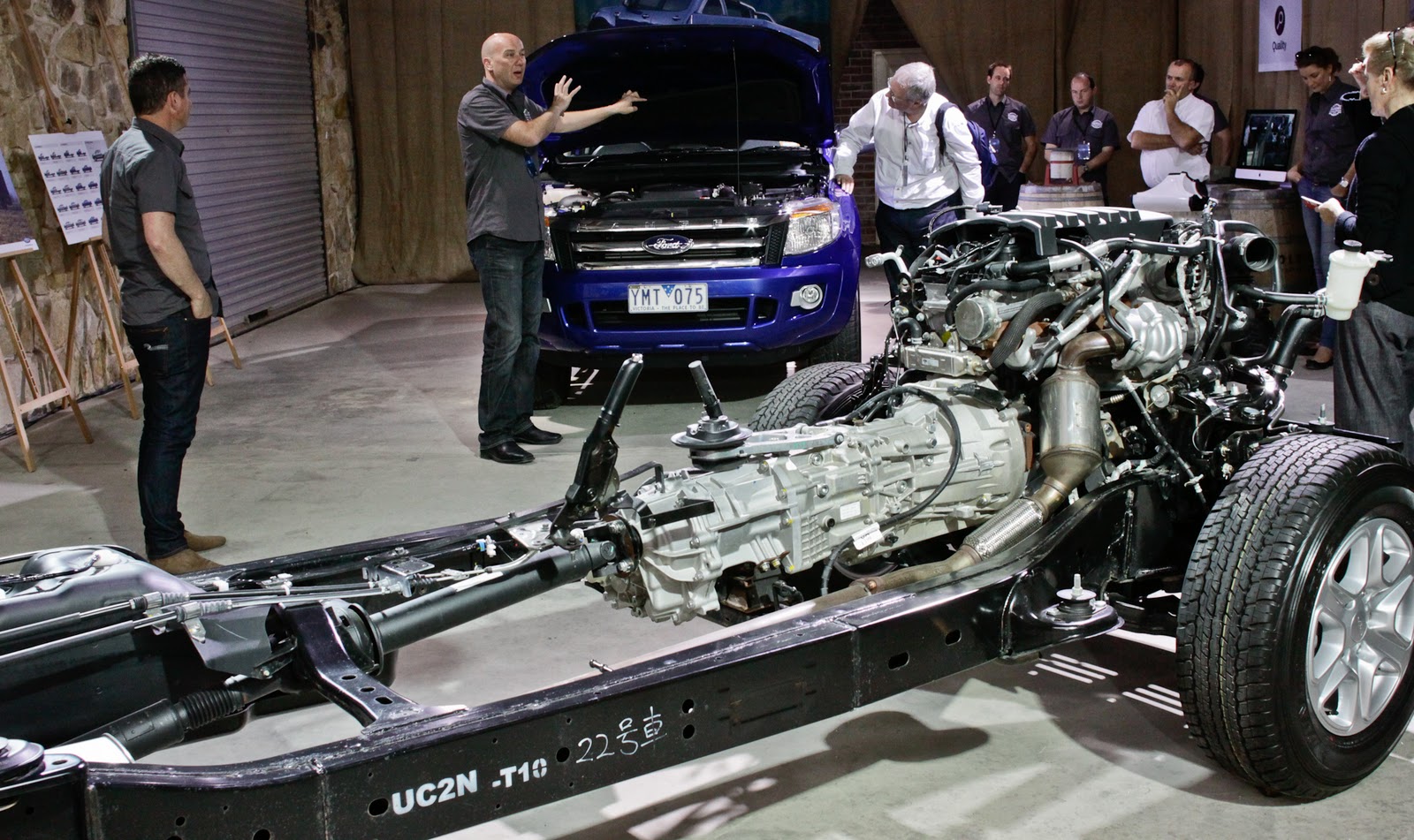
Changing times call for changing ideas of what a chassis should be like. Ford ditched the plans and jigs for Ranger’s old underpinnings and came up with a new sexy-looking chassis – the longitudinal rails are curvy – for a whole host of reasons, but perhaps primarily to provide killer (in the good sense) crushability. Whack this baby into a wall at 50km/h (see photo) and the cabin doesn’t know anything’s happened. Other reasons included better rigidity, addressing NVH, and improving driveline clearances for off roading.
Gary Boes, the American who headed the Ranger programme, discusses the vehicle during the launch.

800mm of wading AND a factory snorkel

A Land Rover Defender can only wade in 500mm of water due to the stupid placement of its air intake. Some can wade at 700mm; few can manage 800mm. But there’s more, in the form of an optional factory snorkel. This wasn’t something worked up by Safari or Airflow, but designed in Ford’s offices as part of the overall project. It’s said to blend unobtrusively with the A pillar and not create a blind spot. And you don’t have to chop into the sheetmetal, simply unbolt the side fender grille, as Ford calls that piece of decoration between the wheel arch and door (see photo), and bolt-on the snorkel. Unfortunately none was shown at the launch, otherwise there would be a photo here.

Electronics galore

Ranger has more electronic aids than you can shake an acronym at and brings to ute owners the full suite of gizmos that owners of mid-price and above cars have enjoyed for some years. Good on them for that. The off-road electronics are the best I have encountered. Ford took us up some steep, hairy and loose trails in the Flinders Ranges of South Australia and the traction control responded with a degree of easy precision that I’ve never before experienced. It was so good, and worked so well without having to pump-on acceleration to get it going, that not once did we have to resort to the rear locker (see below). You might think hill descent control (HDC) would be pointless on a diesel, particularly a manual diesel, but it isn’t. We went along a number of trails that could easily be driven in high range, yet with some really steep downhills that would have required either low range, lots of brake, or maybe both. With the HDC (you can leave it on, ready to work when needed), the driver can head into the descent and let the electronics do it all. The rate of descent can be altered by the driver. My favourite way was via the cruise control switches on the steering wheel. Like all good HDCs, Ranger’s also works with the box in neutral. It takes a bit of guts to try this on a really steep descent, but man does it work well.

Fantastic off-road electronics

Ranger has more electronic aids than you can shake an acronym at and brings to ute owners the full suite of gizmos that owners of mid-price and above cars have enjoyed for some years. Good on them for that. The off-road electronics are the best I have encountered. Ford took us up some steep, hairy and loose trails in the Flinders Ranges of South Australia and the traction control responded with a degree of easy precision that I’ve never before experienced. It was so good, and worked so well without having to pump-on acceleration to get it going, that not once did we have to resort to the rear locker (see below). You might think hill descent control (HDC) would be pointless on a diesel, particularly a manual diesel, but it isn’t. We went along a number of trails that could easily be driven in high range, yet with some really steep downhills that would have required either low range, lots of brake, or maybe both. With the HDC (you can leave it on, ready to work when needed), the driver can head into the descent and let the electronics do it all. The rate of descent can be altered by the driver. My favourite way was via the cruise control switches on the steering wheel. Like all good HDCs, Ranger’s also works with the box in neutral. It takes a bit of guts to try this on a really steep descent, but man does it work well.

Flexible five-cyl motor with 470Nm of torque

What a cracker of an engine. Developed by Ford-PSA, the 3.2 litre turbo diesel produces 147kW but more important, 470Nm of torque anywhere between 1500rpm and 2750rpm. That wide range of peak torque allows you to do silly things with the manual, like start off in third. In fact, third really is a hero all-purpose gear. The other thing is that it puts Ford at the head of the torque race that’s been going on among ute manufacturers, at least until Nissan gets the (probably expensive) 550Nm Navara into its local pipeline.

Engineer discusses the new engine.

It just goes on and on

Wow, an 80 litre fuel tank (a capacity shared with the Nissan Navara ST-X). Teeny, still, compared to some Land Cruisers, but you don’t usually see a juice holder of this size on a ute. Drive with economy in mind and you’ll not need to stop for 1000km. Or go bush without a jerry can or two n the tray.

Things that aren't so great about the Ranger

  • You'd think with all that development work they might have come up with a transmission that can be used full-time on-road in 4WD, like the top Triton.
  • With a curb weight of around 2160kg for the top Double Cabs, it's a heavy bunny. Hilux SR5 and Triton GLS are in the low- to mid-1900s.
  • Approach angle of 28deg is fairly modest. Triton GLS can do 30deg.
  • Turning circle of 12.7m is unremarkable; the Triton manages 11.8m, but the Navara D40 needs 13.3m.

September 28, 2011

Does this make it a Land Ranger?


Here's a bit of a surprise, the latest Land Rover Defender engine at the Ford Ranger launch. Well, it's not quite like that. The Defender engine comes from Ford, and it's one of three available in the new Ranger ute. However, we won't be seeing much of the four cylinder turbodiesel in the Ford, as it's available only only a few models to special order. New Zealand's range is based around the more powerful five-cylinder sibling. The cutaway was well done and quite interesting to watch in action, powered by a hidden electric motor.  Here's an earlier posting on the engine.