January 1, 2011

Beam there, done that

Land Cruiser 70 wagon, one of the final five with beam axles front and rear. 
It didn't take long to compile a list of 4WD wagons (but not utes) sold new here that still have beam axles (aka live axles or solid axles) front and rear: six items. It may be that some of the sophisticated all-independent setups can match a good old twin beam arrangement in really rugged terrain, especially with electronic traction control to help force them along, so it might be admitting Luddite leanings to say that I have a preference for solid axles. One key reason for choosing my Jeep Wrangler Rubicon 2-door was because it still has them. The list:

• Jeep Wrangler
• Land Rover Defender
• Mercedes-Benz G-Class
• Nissan Patrol
• Suzuki Jimny
• Toyota Land Cruiser 70-series

I know die-hards will be tut-tutting along with me at the small choice, and grimly predicting that the writing is on the wall. This may well be; the next Patrol we get is all-independent and the next Defender almost certainly will be. However, the decline has hardly been recent. I went back 15 years and found the New Zealand market was offering only seven all-beam wagons, just one more than today! The list then comprised the Jeep Cherokee, Jeep Grand Cherokee, Land Rover Discovery, the Range Rover, Nissan Patrol, Suzuki Samurai and Toyota Land Cruiser 80. Everything else was fitted with the flavour of the day, independent front suspension with a beam axle at the back, usually on coils but with some holdouts still on leaf springs.

NOTE: This list was updated in March to include the Mercedes G-Class, (right) which is now part of the company's lineup. Great to see the group grow by one!

Nothing stops a good beamer. Most of the time.

A timely reminder about hot cats and dry grass

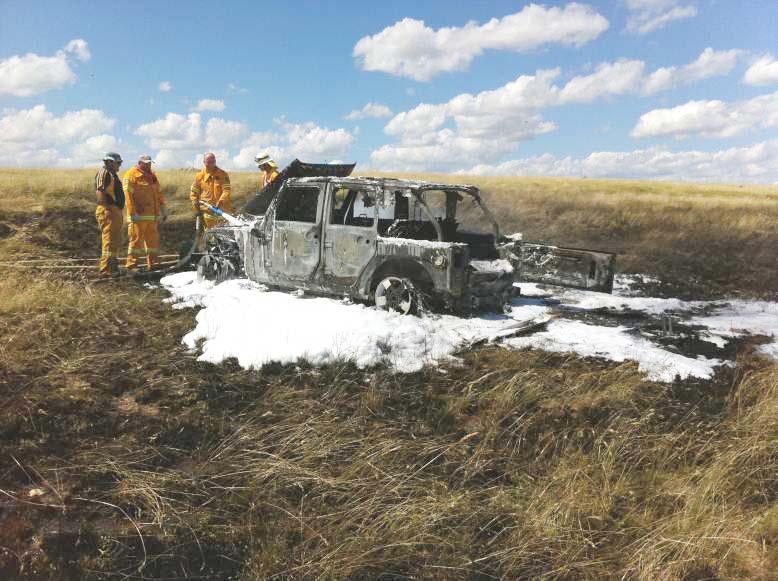
This is from the Australian Jeep Offroad forum and I'm passing it on because it underlines the danger of stopping for any time when there's dry grass under your truck's hot catalytic converter, and/or other parts of the exhaust. The unfortunate driver had stopped in a paddock of bonnet-height grass including spinifex on the family property near Canberra and smelled smoke …  it apparently took only about 15 seconds to go from smell to raging fire. You can see the full item here. One person responded with this advice:

"Once you realise you are on fire there is so much grass fuel built up that the fire builds quickly and intensely. BCE extinguishers need to be shaken occasionally to loosen the powder or you waste half of the propellant without the chemical. They need to be upright, pointing at the fire. Pretty hard to do unless you have over 16 inches of clearance at the sill to aim at the exhaust with extinguisher upright. A piece of hose a few feet long attached to the end of the extinguisher can be a life saver. Just because the flames are out doesn't mean the fire is done, the resin on the cat can still self-ignite without warning."

December 31, 2010

Prado gets a petrol V6 as fuel prices soar

Toyota is celebrating our near record fuel prices by introducing a petrol V6 to the previously all-diesel Prado lineup. It's on the top VX Limited version only and will cost $106,690 when it arrives in showrooms during the next couple of weeks. Apparently the marketplace has been asking for a V6, so the ever-obliging Toyota has responded with the 4.0 litre 202kW and 381Nm (at 4400rpm) unit. The petrol Prado, like the diesel, is rated to tow an unimpressive 2500kg braked and 750kg unbraked. Toyota overlooked mentioning fuel consumption in its press release, but a recent overseas test of this model returned 15.3 litres per 100km overall. The diesel's official figure (as opposed to what a driver might actually get) is 8.8 overall. I'm wondering whether there has been a heartfelt cry for a petrol motor, or whether it's a response to the anaemic nature of the diesel, which now has all that extra bulk to pull around.

Here's an earlier Prado-related item.

December 29, 2010

Remove battery before chucking old locator beacon

This item from today's New Zealand Herald reports an unintentional consequence of throwing out an old locator beacon without first removing its battery.

The pilot of the Taupo Youthtown Rescue helicopter is urging people to take the batteries out of emergency beacons before throwing them away, following a callout that ended at the Taupo rubbish dump.
Nat Every, the helicopter's pilot and base manager was alerted by the rescue coordination centre this morning of a emergency locating beacon activated that was heard as far away the Kapiti Coast by an aircraft at 16,000ft.
"After a brief airborne search followed by a ground search a ELT beacon was found at the Taupo landfill under about a foot of rubbish," Mr Avery said.

December 28, 2010

An important new 4WD book

4WD Handbook
The Complete Guide to how 4WDs work & how to drive them off-road
Robert Pepper
Boiling Billy Publications, 2010, 522 pages
ISBN 9781921606175 $AU44.95

There are plenty of books on 4WDs and how to go about it, but some are better than others. And this newcomer from Australia is one of the best. Although from Oz, it's largely devoid of photos of vehicles stuck in orange Outback dirt; were it not for the number plates, most of the photos could have been taken in New Zealand, give or take a gum tree or two. Not that pretty pictures make a good 4WD book. This one scores because of its comprehensive coverage and because it embraces the latest electronic advances that some others barely acknowledge, perhaps in the hope that they might go away. So this is a rare publication, one that is electronics- and soft-roader friendly, yet has all the stuff for the  hard-yakker, or would-be hard yakker, club enthusiast.

The softcover volume is easily read, thanks both to the author's clear writing style and good layout, even though it annoys me that section headings begin with a lower case letter. perhaps someone will speak to the designer. The photos, backed up with diagrams, range from good to brilliant and help illustrate the point being made in the text. The text's broken into four sections and various appendices (one of which is on how to splice synthetic rope – talk about comprehensive!). The first part covers the basics of 4WDs and how they work; then it goes onto driving techniques, recovery and touring. The Touring section is about how to do it, not where to go, so we're saved endless descriptions of tracks in the Red Centre. Naturally there is an Aussie bias because it's a book primarily for an Australian audience, but most of the information applies perfectly well to New Zealand or other countries.

I reckon one way to tell a good 4WD book is how it deals with the subject of failed ascents. Some give advice that is now widely regarded as dodgy (like whipping the gearbox into reverse in that moment between when the truck stops moving forward and starts sliding backwards – a technique I admit to having used), some others make it seem so complex I'm left wondering what they're trying to say. The 4WD Handbook, however, does a good job. It's possibly the most thorough I've read and not only gives two alternative methods for manuals and two for automatics, but has a whole extra section for drivers of soft-roaders.

No book is a substitute for practical experience, but I've pretty much read the 4WD Handbook cover to cover and am better for it, picking up useful points and having my memory jogged about others. It was like having a 4WD refresher course without having to go off-road or even sit in a vehicle. I was even able to drink beer while "virtually" descending on a slippery sideslope.

A website supports the book with updates, corrections, references and other stuff. There's also a page New Zealanders can use to buy the book until it becomes available in our shops. It's here – scroll down the page to "New Zealand".

We have a Kiwi connection, too. Author Pepper used to drive with the Auckland 4WD Club, before moving to the Lucky Country where, among other things, he's an off-road instructor and journalist (Overlander, etc).
Phil Hanson

Interested in new 4WD books?: There's another review here.

My other favourite 4WD how-to books

Four Wheel Drive Handbook
James T Crow and Cameron Warren
Parkhurst Publishing 1970
My first 4WD book, purchased for $US2.50 back when – in North America – the question was whether to buy a Ford Bronco or a Chevy Blazer rather than a Jeep. Or maybe an International Scout if you were a bit of an oddball. Only 96 pages and written purely for American audiences, the book is brief and to the point and, 40 years on, rather quaint. It deals with such hot topics of the day as whether you should specify such new technology as power steering and power brakes. Mud driving gets all of about … one or two paragraphs. But I still come back to this book when I want to brush up on things like hi-lift jacking – almost nobody had a power winch back then. Here's one of my favourite photos from inside, predicting in a slightly clumsy way the arrival of the Sports Utility Vehicle (SUV):

And now, in alphabetical order:
4WD Survival Guide
John Basham
Gregory’s Publishing, 1998
Glovebox sized (more or less) and 152 pages thick, this nicely designed full-colour Australian book has over the years provided me with heaps of useful information. It’s somewhat Aussie biased but there’s more than enough that’s relevant for drivers over here and it deals with the types of vehicle and equipment that we know, use and try to understand.

Jeep 4x4 Performance Handbook
Jim Allen
MBI Publishing, 1998
Forget about this being a Jeep book, although owning one of these American vehicles makes the content even more cost effective. I had my copy all through my Land Rover years and used it often. Within its 192 pages is a mine of information about four wheel drives and four wheel driving, including how to go about an upgrading programme. Well written, easily understood and lots of photos.

Land Rover Experience, The
Tom Sheppard
Published by Land Rover, 1994 (second edition)
And forget about this being a Land Rover book, although owning one of these British vehicles makes the content even more cost effective!  This 210-page volume is the all-time classic book on four wheel driving and off-road driving technique. No matter where you’re going or what kind of trouble you might get into, Tom Sheppard will help you get out, or avoid it in the first place.

New Zealand 4 Wheel Drive Handbook, The
Ken Sibly
Shoal Bay Press, 2004
It’s ring-bound for easy use, its glovebox sized, it’s 264 pages, it’s chock-a-block with information and it’s an all-New Zealand publication. It grew out of the 4WD North Island and 4WD South Island books, by Andy Cockroft and Ken Sibly respectively. These included a substantial section on 4WD techniques, trip planning and so on. The handbook is mostly black and white and relies heavily on illustrations rather than photos but this is a strength. This book is essential if you're in NZ. No matter what other 4WD books reside on the bookshelf, you must also have this one.