July 17, 2010

Good enough for a dirty weekend


For 4WD people who wanted a good, honest wagon of real ability, the Mitsubishi Challenger (photo above) ticked all the boxes. Then It was discontinued. Now it's back (top photo), still based on the Triton ute but more refined and more capable than ever. It doesn't have heaps of ground clearance, but on the right trail the new version is a real weapon, thanks to its standard mechanical cross-axle diff lock. It still has that breathless scrabbling for traction typical of today's crop of electronically traction-controlled off-roaders, but when you want to get serious, flick the diff-lock switch, choose a good line and you're off.

Its 2.5 litre common rail turbo intercooled diesel delivers 133kW of power, and 356Nm of torque and although a hearty unit, it's not the quietest or smoothest unit in its class, judged from inside the cabin. Mitsi designers have also taken their eye off the trail and focused instead on the school run, so its body design is also likely to collect more dings and dents than its predecessor if taken bush.

But with seven seats, most of the goodies, good fuel economy and probably low running costs, the Challenger is a contender as a family all-rounder that can get its occupants through, and back from, the occasional dirty weekend. Pricing's good, too, at $56,990 and up (that's just two grand more than the top Triton ute), whereas the cheapest Pajero is almost $74,000.

Three rules for off-road driving


An article I’ve had in my files for years argues that there are only three main rules for good off-road driving. I no longer know where it came from or who wrote it, so apologise in advance for any plagiarism, because the points are sound and worth sharing.

Knowing the vehicle’s ground clearance and what’s underneath. If there’s not much air between the ground and, say, the diff heads the chance of getting stuck on a rough track is good. If there’s something like a transfer case hanging low, learn where it is in relation to the driver’s seat and try to avoid it hitting something. If there are long front and/or rear overhangs, you’ll be unlikely to be able to tackle sharp rises without wrecking a piece of bodywork,

Know where your wheels are. “Be it rocky country, a deeply rutted trail, or a narrow-benched cutting,” the article said, “it’s usually critical to know exactly where you are placing your wheels [even if one's airborne like the Isuzu's in the photo].” I can relate to that one, having over the years had one hit and several near misses due to not knowing.

Be in the right gear at the right time. “If you have the right gear selected for a particular trail, it’s surprising how far you can travel without the need to change gears. Working back from there, it follows that the right gear will take us the greatest distance without gear changing. Clearly, the wider the torque band delivered by your engine, the more this principle applies. But on any typical trail, it is usually possible to travel most of the time in one gear.”

Mister Blobby and other Toyotas


I know everyone loves the Toyota Prado, sales figures and enough glowing press reports to light a small town tell me that. But I’m sorry to say I cannot warm to the current version of this immensely popular mid-sizer (photo above). I did like the first version that came to New Zealand as a 4Runner replacement and even quite liked its successor. But now the Prado has grown big and podgy and makes no sense at all. Its body design needs a complete re-think, it needs to be lighter or be given a more powerful engine. It has grown to be over-specced and too expensive, the top version now costing $105,000.
And typical for the car industry, all the good off-road gear is only available on the top models, not the base one that you might think people would choose for using off-road.

I’ve also been driving the latest Land Cruiser 200 (top photo), which you might think I’d like even less, but it remains on my favourites list. For one thing, it makes a superb long distance cruiser – probably the last thing designers envisaged when they devised the original almost 60 years ago. Owners of performance oriented GT-type cars may scoff, but let me put the case. Its overall size and footprint on the road lets it eat the miles while conveying whole families, their pets and assorted junk in superb leather-clad comfort; the twin-turbo 4.5 litre V8 diesel calls on its well of torque that’s 650Nm deep to do safe quick-draw highway-speed overtaking runs; outward vision is superb courtesy of the high seating position and excellent outside mirrors. Even fuel consumption is quite impressive. I took it from Auckland to the most recent Fieldays and back at 12.8 litres per 100km, although the economy falls apart in town when it quickly climbs into the 15-16 litres per 100km range. Toyota’s Tui billboard lab-test figures reckon it’ll do 10.3 litres per 100km, overall.
People tend to go on about the Land Cruiser’s size, but at 4950mm long and 1970mm wide, it’s only 56mm longer and 71mm wider than a VE Commodore.
Off-road the Land Cruiser’s prowess is undoubted, assisted these days by various electronic aids, but you need to choose where it’s taken off the road, because it’s simply too big for many of our typical tracks and trails. So panel damage to your $135,000 pride and joy is almost inevitable.
In a Politically Correct world, the Cruiser 200 would not exist; all four-wheel-drivers would be running around in Suzuki Jimnys, but in the real world, especially the Third World and in war zones, the 200 and its rival Nissan Patrol are tough, dependable workhorses. Their level of specification is often quite unlike the tarted-up one we get here. I wish Toyota would give us a basic 200 in New Zealand but they respond with a reply that includes the words "hell", "freeze" and "over". They reckon there just isn't the demand. Pity.

One thing leads to another


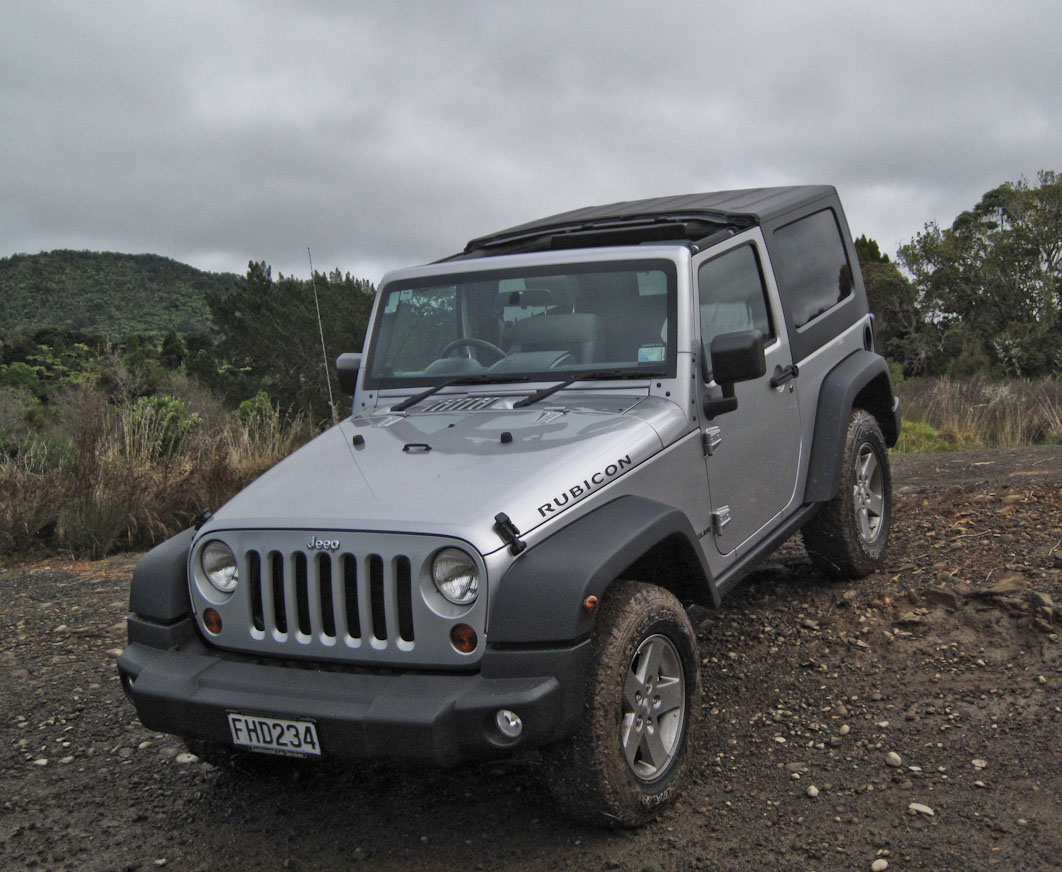
One of the problems with modern 4WDs with front crumple zones is finding somewhere to fit rated recovery hooks. Even my Jeep Wrangler Rubicon, supposedly the Jeepest of all Jeeps, has this problem. Mopar offers a solution, but the factory product is rated below the 10,000lb that event scrutineers and club safety officers here often prefer. So I thought I'd ask ARB if its Wrangler bumper has recovery points like those on my old Defender bumper. Even these drew the ire of some scrutineers so I always carried a letter from ARB saying the points were suitable for snatch recovery so long as a rope
was used with 20 per cent or more elongation. Yes, the Wrangler bumper does have recovery points. No, ARB will no longer write me a letter. Then Stuart Cocking of Motortech 4x4 and I worked out how we could fit rated hooks to the bumper that would make everybody happy. All good. Then I become worried about the bumper's weight, which is about 55kg on top of the 16kg Mopar skid plate I've already fitted. I weigh 55kg worth of stuff and load it onto the stock bumper, which immediately causes the Rubicon to go arse-up and sink some 1.5cm on its front springs. Well, I could always get an ARB lift kit with stiffer springs and ... now I'm into about $3000 worth of mods in order to fit a couple of $30 hooks.

My plan for upgrading the Wrangler was to mess with it as little as possible. No lift kit, no unnecessary added weight, just some slightly larger tyres (the new Kevlar-bolstered asymmetric Goodyear MT/Rs), decent shocks, underbody protection, an on-board air compressor, etc. It comes standard with front and rear diff locks and a disconnecting front swaybar. So I gave myself a reality check and ordered the Mopar hooks from the US, the ones that seem to satisfy the needs of thousands of American and other off roaders. If some safari scrutineer doesn't like them, I'll just have to go home. Meanwhile, though,
club safety officers and organisers of tag-along safaris should seriously think about the realities of using modern vehicles off-road. The days when you could bolt some hooks any old place on the front of the chassis and then snatch-recover the buggery out of it are for the most part well and truly over.

December update: Sure got the above all wrong. Here's a newer posting.

Nothing but a club whore

The Auckland 4WD Club of the mid 1990s was a wonderful group … at least in my eyes because its calendar of activities coincided nicely with my interests, which were off-road touring and exploration with plenty of challenges along the way. But slowly its emphasis changed to winch challenges and tough ’wheeling. Nothing wrong with that, of course, and a real bonus for those who wanted to spend a pleasant day out winching in the mud. So I did what I said I'd never do and joined a single-make club, in this case the Land Rover Owners' Club of Auckland. I really had nothing against single-make clubs other than I always found it interesting to compare how different types of 4WD tackled the same challenges. The Land Rover club turned out to be a good choice and had some interesting trips, but I had to skulk away after selling my Defender 90 of 12 years and buying another make, to make matters worse an American one beginning with 'J', that many Land Rover owners love to hate! Fortunately for me, by this time the Auckland club had lost some of its hard edge and was now closer to the way it was when I first joined. So now I'm back, but I remember the LROCA with fondness and, as a way of saying thanks, offer these photos from the last time I was in Waiuku forest with them. The forest is located on the west coast south of Auckland and is not open to the public; that's one advantage of being in a club.